
Family Perspectives on Improving Services for Adults with Developmental Disabilities
An Opportunities Mississauga for 21+ Survey Report (2009)
This report is designed to bring the voices of more than 120 families into the discussion of “transforming services” for Ontario adults with developmental disabilities. The voices are all from one community – Mississauga – but we strongly believe that families across the province would echo the expressions of anxiety, hope, and imagination that emerged from the survey we have undertaken over the past year. We also strongly believe that these voices and expressions can make a qualitative difference to the design or re-design of programs and services.
Our recent gathering of data and opinion was actually a second survey effort for Opportunities Mississauga for 21+. Early on in our group’s existence (2001-2), we undertook a first canvas of community needs. Trillium Foundation funding allowed us to detail a particularly desperate need for “day activity programs” among families whose children with developmental disabilities had reached the age that took them out of the school system. The survey data greatly strengthened the case we were able to make to the Ministry of Community and Social Services – and a funding proposal jointly submitted with Community Living Mississauga helped build “base site” programs that are now life lines for more than 100 families.
We undertook a new survey for several reasons. It was obvious that the passage of time had brought some significant changes to Mississauga: e.g., population growth to more than 600,000 and an ever-increasing measure of ethnic complexity within this total. Our large membership also made it obvious that family concerns (especially for aging parents) had evolved beyond “day activity programs.” It was no small thing, either, that there had been government initiatives signalling a revival of serious attention to long-neglected problems: we very much wanted to respond to those welcome initiatives with enthusiasm and care.
Among other things, we were particularly anxious to develop a more precise picture of substantive needs on the front lines. Everyone in government circles, agencies, and family organizations knows that there are long waiting lists for a whole range of services to adults with development disabilities: figures in the hundreds and thousands are commonly cited. But how are these abstract numbers experienced by the families coping with the needs -- how are the numbers actually “lived” day to day? Many families are on several waiting lists, for example, juggling multiple concerns and needs: what do those families see as their highest priorities?
In our own local efforts over almost a decade – and in regular communication with individuals and organizations like ours across the province – we have found that most Ontario families are remarkably realistic about the circumstances we confront. We know, from often long and sometimes heartbreaking experiences that we – and our children – cannot have and are not likely to get everything we need. We also know two other things, however: first, that we will continue to do our utmost to care for our children in spite of the strains and disappointments we have experienced – but second, that we would like agency and government leaders to pay serious, detailed attention to what we see as priorities as we struggle on the front lines.
This Report presents the results of a survey undertaken by OpportunitiesMississauga for 21+(OM21+) over the past year to document the needs of adults with developmental disabilities and their families in Mississauga.
Data collected from an initial survey (2001-2002) led to a proposal submitted jointly with Community Living Mississauga to the Ministry of Community and Social Services resulting in the development of day time “base site” programs for individuals with developmental disabilities graduating from the school system. Since that initial survey, however, significant changes have occurred in Mississauga – as well as in the attitudes of the provincial government – and the Board of OM21 + felt it was time to review and develop a more precise and current picture of community needs.
OM21+Board Members, consultants, and families invested an enormous amount of time, energy, and imagination into the survey process – which involved hundreds of hours and drew in the opinions of well over 100 families. We believe the results deserve serious consideration by anyone anxious to work for improvements in existing services and the development of new services.
The survey identified a wide range of family concerns, but highlighted half a dozen as key priorities:
increased residential services
increased respite services
increased daytime activity programs
volunteer and paid work opportunities
a pool of certified, trustworthy support workers
acceleration of government initiatives
In addition to such specific issues, survey respondents also elaborated on a number of general concerns:
a desire for real movement in the “transformation of services”: there is growing impatience about the length of time it is taking to develop the new administrative mechanisms and processes connected with new legislation and serious concern about provision of the budgetary resources necessary for expanded front-line services;
a desire for serious consideration of creative proposals: in difficult economic times, families are prepared to think imaginatively and flexibly about ways to improve services – and both agencies and provincial leaders should respond with appreciation and support;
a willingness to mesh burden-sharing with creativity: families (like those in OM21+) will work to expand local community capacity and engagement.
OM21+has already begun working on plans and proposals to turn priorities into achievements – and we will be sharing information about these in the months ahead.
The survey used an “action research” approach – meaning that the people ordinarily ‘studied’ by outsiders became, instead, the authors of their own research.
The research was done in two phases, with “round one” focusing on defining “the problem” and “round two” exploring “solutions.”
Round One -- Survey design and execution: determining survey questions and methods, administering the survey, tabulating results – with the process aimed at updating the map of service needs of Mississauga adults with developmental disabilities and their caregivers.
Round Two -- Analysis of survey results and setting of priorities: Facilitated discussion of survey statistics and their relative importance – as well as focused consideration of priorities and action plans.
Round One:
Mike Balkwill and Anna Przychodzki were retained as consultants;
An OM21+sub-committee comprised of Bob Chassels, John Wakeford, and Natalie Whatley drafted a questionnaire with the assistance of the consultants;
Anna Przychodzki conducted a “test” round of seven interviews with members of OM21+;
Several interviewees (Cresencia Aquino, Bessie Chow, and Sheila Swinton) then joined the sub-committee and a review of the “test” survey results allowed final revisions were made to the survey instrument.
The committee decided upon the following process for administering surveys:
There would be distribution of the survey through a variety of means – email, mailing to OM21+membership list, and distribution through community service agencies. The survey could also be completed online (approximately twenty-two were completed that way). The eventual list of agencies that were contacted included: (see next page)
Peel Board of Education/Applewood School
Applewood Parents
Autism Society of Ontario, Peel Chapter
Chinese Parents' Group
Christian Horizons
Coalition for Persons with Disabilities, Ontario Women's Health Network
Community Living Mississauga
Dufferin Peel Catholic School Board
Erinoak
Geneva Centre for Autism
OPTIONS
Peel Case Management
Peel Children’s Aid Society
Respite Services.com
In addition to written and online surveys, personal interviews were conducted by Anna Przychodzki. The original target was twenty-five interviews, but the information generated in this way was of such interest that sixty-three were eventually completed.
Round Two:
The results of the written surveys and personal interviews were summarized into a document called the “Caregivers Planning and Action Agenda.”
Two meetings were then held – one in the morning and one in the evening, in order to accommodate people with different schedules. A total of sixty people attended the two meetings.
Participants reviewed the “Caregiver Planning and Action Agenda” and the complete list of issues raised by caregivers in surveys and interviews:
Some issues were identified many times in the surveys and interviews and others came up only once or twice -- but none were left out of the written report presented to those participating in the meetings. This was done to acknowledge the full range of unique needs that are evident in the community – and to make it clear that while some issues were important to only a few they would not be ignored.
The report did not rank issues by the frequency with which they were identified in the written surveys and interviews. Instead, those participating in the meetings were themselves asked to jointly set priorities after opportunities for discussion built into the meeting agendas. Priorities were set using a method called “dotmocracy”. (Participants each received a strip of 11 “sticky dots”. They worked with a large poster of the full list of issues identified in the “Caregivers Planning and Action Agenda” and applied dots beside the issues that mattered most to them. Participants were able to apply “dots” in any combination they wished – one each for eleven items, for example, or two or three dots for a few items).
The results
of the “dotmocracy” exercise are presented next figure: 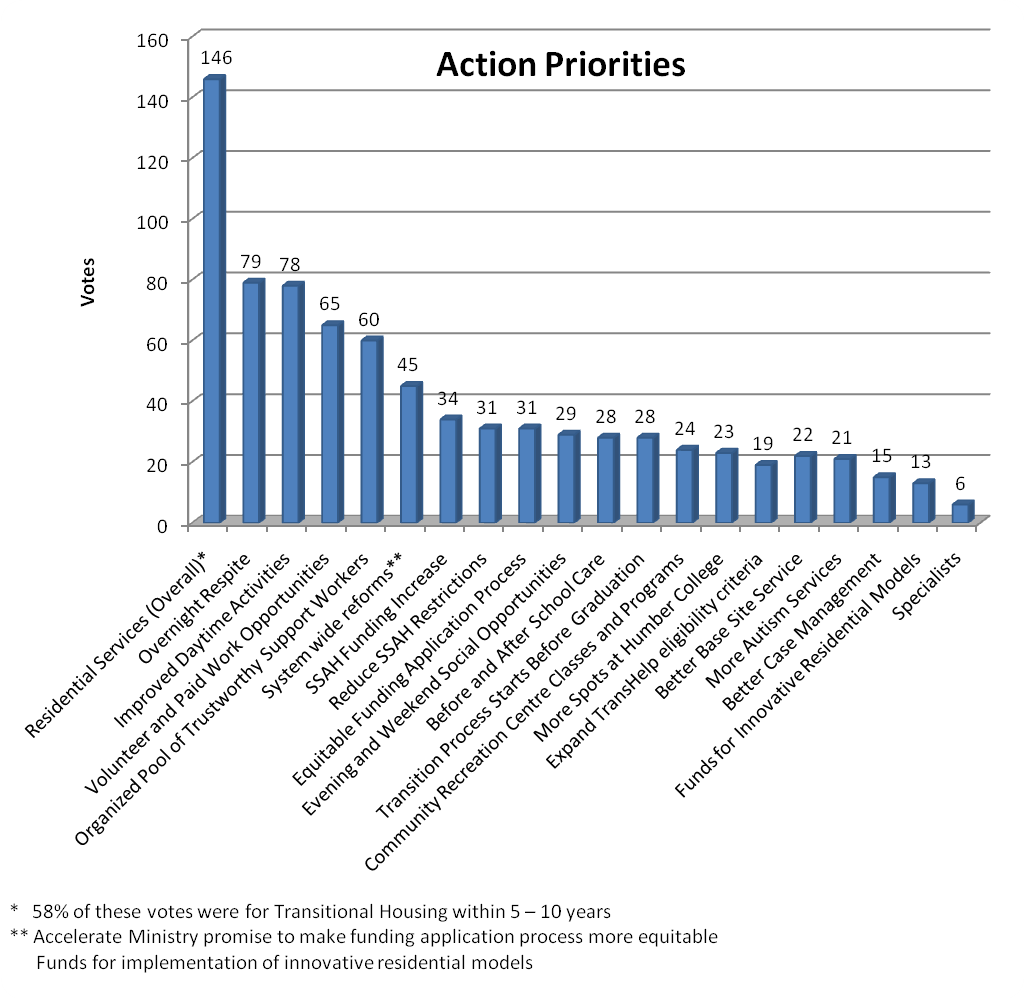
Priorities
Surveys, interviews, group discussions, and the “dotmocracy” exercise produced a richly textured picture of family and caregiver priorities. On one hand, this means that our organization moves forward with a clear set of specific objectives regarding the programs and services that are seen as of greatest importance to our members and friends. On the other hand, our multi-stage survey process highlighted a number of general concerns and anxieties that will also be very much kept in mind as we seek to improve the lives of Mississauga adults with developmental disabilities.
Specific program and service priorities:
A striking pattern emerged on this front. There were six issues that clearly rose to the top of the “dotmocracy” tally, for example – and each is clearly of special concern to a significant number of survey participants: “residential services,” “respite,” “improved daytime activity programs,” “volunteer and paid work opportunities,” “a pool of trustworthy support workers,” and “acceleration of government initiatives.”
Within this group of six, it is important to emphasize that the “residential services” heading received essentially twice as many votes as any of the subsequent five.
This significant emphasis is not surprising – given the fact that “residential services” has long been the most seriously neglected component within the range of supports required by adults with developmental disabilities. Time and again, parents and other family members indicated that this was the problem that could wake them up with worry in the middle of the night – that this was the problem that remained an especially gaping hole in efforts to plan for the long-range security and well being of their adult child or sibling. This priority – this message – needs to be appreciated by the provincial government and the Ministry of Community and Social Services.
To repeat, however, the other five priorities identified through the survey process also merit serious attention and effort:
With respect to “respite,” discussions indicated several particular concerns: e.g., a strong preference for new or expanded facilities within Mississauga (as opposed to the current primary reliance on an Oakville service that make it impossible to access established daytime programs) – and a desire to see richer programming within a respite service (as opposed to minimalist “babysitting”).
Identifying “improved daytime activity programs,” survey participants were concerned about both the number of spaces available (with an eye to minimizing or even eliminating waiting lists) and (yet again) the quality and richness of the programming within established facilities.
There was also a clear sense that programs designed to explore and facilitate “volunteer and paid work” opportunities should be expanded beyond current levels.
Many survey participants also testified to the frustrations inherent in finding “trustworthy support workers” – indicating problems with rapid turnover and training, among other things. Even when funding is available through programs like “Special Services at Home,” effective utilization of the financial resources can be difficult.
While there was clear appreciation for the provincial government’s “transformation” intentions and initiatives, there was also a sense that progress on matters like provincial assessments of individual needs could be more rapid than it has been. In this area, concerns were also expressed about the dangers of additional government resources being directed toward administrative procedures as opposed to service and supports delivery.
Families also overwhelmingly emphasize the importance of developing a fuller range of services aimed at residential and respite needs. E.g.: although we recognize how lower cost “supported independent living” funding can generate a more dramatic statistical impact on the raw numbers of a “waiting list,” for example, our front line experience makes it clear that such an approach has led to the serious, long-term neglect of a population with moderate and higher-level needs. It is long past time to make meaningful progress across the spectrum.
On both the practical and the psychological fronts, families feel an intense need for a sense of real movement in the “transformation of services.” Those who have been carrying the burdens of caring for sons and daughters for two or three or even four decades are often close to (or beyond) the point when despair and burnout will multiply parental health problems and overall family wellness: clear evidence of meaningful action is vitally needed. Even if new initiatives only gradually unfold, they must be designed to genuinely close unconscionable gaps.
“Real movement” would be more conceivable if earlier “transformation of services” rhetoric about creativity informed action plans. In difficult economic times, in particular, families are prepared to think imaginatively and flexibly about ways to improve services – and both agencies and provincial leaders should respond with appreciation and support.
Families are also prepared to mesh burden-sharing with creativity. Among other things, survey participants echoed a regular Opportunities Mississaugaemphasis on playing a hand-on role in the work of expanding community capacity: e.g., using personal contacts and outreach to faith communities, social and recreational organizations, and local businesses to mobilize both financial resources (for capital expenses, among other things) and human resources (for program enrichment and social networking).
At the end of the day – and at the end of this particular survey process – it seems clear to survey participants and the Opportunities Mississaugaleadership that meaningful provincial responses to the needs of adults with adults with developmental disabilities will have an admirable triple impact:
Expanded, sensitive, and creative provincial support will enrich the life experience and citizenship opportunities of a vulnerable and consistently neglected segment of the population;
Expanded, sensitive, and creative provincial support will respond to the needs of families who have been carrying heavy burdens for decades – helping to stave off burn-out and health crises that would otherwise severely strain the existing system.
The reduction of burn-out and health crises will also allow families to go on shouldering a share of their responsibilities (as they are anxious to do) while working to augment overall community capacity (as they are especially capable of doing).
While OM21+’s survey is seen as a foundation for long-term action, some steps have already been taken to begin easing anxieties – and to begin turning hopes into achievements. A few examples:
Both long-time and new members of OM21+have organized a number of action teams to strategize about tackling the highest priority issues – residential services; respite programs; and employment and volunteer opportunities.
More than a dozen survey participants worked intensively to prepare testimony for Parliamentary hearings dealing with “Bill 77” (formal title). Three representatives were invited to speak in person at Queens Park – and the group followed up with both a written submission and consultation with Mississauga MPPs.
Encouraged by survey participation and suggestions, OM21+has also begun an intensified campaign to reach out to the broader Mississauga community – and beyond. Included here, for instance, are discussions underway with the Retired Teachers of Ontario (Peel Chapter) about developing volunteer engagement and advocacy collaboration.
This survey represents many hours of commitment by many individuals. The results - the six highest priority items are listed below - were not a surprise to OM21+. It is what we have been hearing for a number of years from our membership but now we have the information and data to back it up.
Increased residential services
Increased respite services
Increased daytime activity programs
Increased number of volunteer and paid work opportunities
A pool of certified, trustworthy support workers
Acceleration of government initiatives
We know that these priorities are echoed throughout the province through our association and communication with other family groups. OM21+has already formed subcommittees to deal with priorities. OM21+knows we cannot achieve succeed on our own; we need to co-operate/ partner with the government and agencies to produce meaningful, lasting change in how these priority issues are dealt with. If anyone would like to assist OM21+with these endeavours, please contact us through our web-site – www.om21.ca.
The survey questionnaire and detailed survey results/statistics can be found on the OM21+ website, along with a host of other relevant material.
Note to the Reader
All contributors report that there have been no fundamental changes in their circumstances from the time that these testimonials were gathered (fall 2007) to the time that this report was published (spring 2009).
“She’s been listed for a home for 14 years.Every six months we update the paperwork and wait some more.”
A Mississauga mother has devoted half of her life to the care of her now 32-year-old daughter Charlotte. Charlotte needs all personal care done for her and is prone to having seizures at any time. While Charlotte was in school, this mother worked just a few hours a day in a school cafeteria for minimum wage so that she could be free to care for her daughter after school, in the summertime and on school breaks. When Charlotte graduated from high-school, this mother had to quit that job to be with her daughter full-time, until a special day program became available. At age 62, this mother is ready to begin her daughter’s immediate transition to a “good” group home. Trouble is there are no vacancies.
“She’s our only child. I appreciate every moment because I’m getting older. It’s not easy to think of anything but her. I give her my best while I’m alive. I think every minute is worth it.
“I don’t have a life. I have nothing in common with most people. Going to the gym, parties, weddings – these things are not part of my life. I’m only friends with others like me, people who speak my language.
“When we were younger, we thought only of her. But we’re old now; we want time for ourselves. My husband works double shifts. We’ve had a lot of stress for 30 years. It’s not easy looking after a 30 year old. I follow her routine. I feel really tied down. There are lots of things I’d like to do that I can’t. It’s so tiring to bathe her. She is always having seizures. I am not really, really suffering. But someday I’d like her to be in a nice home.
“People like us should get CPP at 65. With a kid like this nobody’s paying our CPP.”
“We’re highly taxed in this country. Where does the money go?”
Another perspective…
“I strongly feel it would be unfair to leave her siblings responsible for her care. And retirement should be time for yourself. But it seems like it’s always a crisis that gets them placed in a group home. Someone in the immediate family has to die or be too ill to provide care. It’s terribly traumatic for the poor person. There needs to be a transition period. She’s 26 – I want her placed now, while we’re still healthy and can spend time helping her adjust. As I understand they’re prioritizing individuals whose parents are now in their seventies. I just wish there was a better way of managing it, instead of waiting till the bitter end.
“When she was 19, we lived in Vancouver. We were offered a residential placement but I wasn’t ready. We were told she only has to be there one day a week. It’s a gradual transition and she can take as long as she likes. I though, Wow! That’s great! Then we moved back to Mississauga. Obviously the difference between here and Vancouver is that there, they allocated a lot more funding.” – A Mississauga mother
2. “Do they mean to tell me it takes $150,000 to be cared for by the state and $12,000* to be cared for by family?”
“Do you think we made the right decision?”asks a sixty-something year old Mississauga mother. In 2006, she and her husband went to the government cap in hand. The stress of caring for their then twenty-year old son Christopher had become too much. Christopher was violent, hyperactive, and running away from home. They begged for funding to hire a live-in caregiver, but a different offer was made instead – and it was take it or leave it. Caught between a rock and a hard place, the couple agreed to place Christopher in a group home an hour’s drive away.
“I wish the government had given us the funds. I wouldn’t have sent him there.We would’ve done some of the personal care, like bathing. I would like my son to eat my own healthy, home-cooked food.”
“It’s not an easy job. He hits, pulls hair. The group home workers try their best, but he’s not their son. There’s no feeling or attachment. They follow a program on paper. If he says he’s hungry and it’s not time to eat, they don’t feed him. They put him in diapers even though he’s been toilet trained all his life. He once wore the same sweater all month. It got so dirty. At home he was always well-dressed.
“Staff turnover happens far too often. He gets used to one person, starts to care – and then he has to adjust. He can’t rely on people. That’s why he starts to act up when a new staff-person comes.
“I can’t speak badly of the government. Sometimes I think we’re lucky. I can’t complain about the house itself – it’s new and he is being looked after. I’m just complaining about the lack of tender loving care.
“It’s heartbreaking for me to see him there like that. Every day we cry because Christopher is not among us.” He cannot express himself with words but you can tell by the expression on his face – when they come to pick him up, you can tell that he doesn’t want to go back. Nobody should be forced to live in a group home. The government should help those families who want to keep their loved ones at home.”
* The annual income for a single person receiving disability support in Ontario is $12,000. Many families have been led to understand that the average cost of care by the state is in the range of $150,000 per single person per year.
3. “These adults are stagnating because there isn’t anything they can do and be proud of.”
A Mississauga grandmother has a dream for her 22 year old grandson Todd: post-secondary education at a level that’s right for him and a job so he can support himself to the greatest possible extent – perhaps reducing the need for life-long social assistance. A wonderful program is offered at the local community college, the only one of its kind nearby. Todd would learn English, math, vocational skills, and gain valuable work experience. But with many applicants (89 people – applicants and their families – attended an information meeting) and only 19 spots, competition is fierce. In 2007, Todd’s application was rejected.
“Recreational programs are out there. Todd has baseball, bowling, and music class; it’s schooling we need. I don’t think you can be proud of going out to play games at 22 years of age. If they’re capable there should be something for them. He needs to have his own life, but he’s not getting that chance. Employers just don't think of development delayed adults as being responsible enough for the job. I think employers, staff, and people in genera are afraid and embarrassed by these young adults. We need to educate the public in general and make sure there are places available for developmentally delayed people in the schools, colleges and business. They need to be trained, not left out of business and schooling because speech, brain and limbs don't work like some other person. That's not how I judge people, and I think people in general need to be made aware, and encouraged to give these developmentally delayed people a hand up.”
4. “I’m almost guaranteed to lose my job come September. You’d think there’d be help for single moms that want to work.”
A divorced single mom in Mississauga wants nothing more for herself than a good job and help with after-school care so she can work a full day. She has already lost the job she loved – helping kids with special needs – because she couldn’t work the late shift when asked (10 a.m. to 6:00 p.m.). Someone has to put her teenage daughter Victoria on the school bus for high-school each morning at 8:00 and be there when Victoria comes home again at 2:30. Victoria has come a long way – she can now get dressed, eat, and use a restroom by herself – but she lacks a sense of safety and probably always will. Victoria will let a stranger into the house – she’s even dashed out the door and down the street a few times.
This mom now has a job and an understanding boss (a long-time high-school friend). She’s allowed to leave work early twice a week and her teenage son looks after Victoria the other three – but it’s an entry-level position that feels like a step backwards career-wise. As bad as that makes her feel, this mom has bigger worries: This fall her son will be heading off to university, and she is all out of options.
“My job is the thing that makes or breaks me. But it’s either ‘Work these hours’ or ‘Thanks have a nice day’. You kind of feel like you’re getting fired. You didn’t do anything wrong, but you just can’t fit in.
“My main struggle is finding care between 3:00 - 6:00. I depend on my son to help out – I tell him I’ll lose my job if he doesn’t. He’s in grade 12 and has ADD. It’s too much for him. He isn’t as attentive to Victoria as I’d like and he probably feels like he can’t do anything right because of course I only mention what he forgets to do.
“When I leave work early I feel guilty, like I’m not carrying my weight. Nobody makes me feel bad but I feel like I’m sneaking out – other people are working 3 hours more! I always wonder what they think of me.
“Typical kids have PLASP but we can’t register for that – she needs one-on-one care at all times, which I would have to provide and pay for at the PLASP location. I can’t find a support worker to come to my house either because the hours are weird (after school part time). I also can’t afford someone five days a week.
“You feel grateful for the government support you do get, you hate to ask for more, you feel greedy, but – my needs are changing as she ages; it’s important. I’m asking for funding top-up. My case worker tells me not to hold my breath. Truth is I have limited to no options unless I find the right caregiver on my own and have the funds to pay for that person! Far more challenging than you can imagine. I am at the mercy of others providing after school care for my daughter and if anything changes I am the one who has to step up and be available for my child and sacrifice being employed once again! Which of course puts a financial burden on the family. And it’s hard on me emotionally not to be working.”
5. “If only I could speak English. I could move heaven and earth.”
Life in Canada is not exactly everything this mother, a forty-something immigrant to Canada, thought that it might be. Like many immigrants, her family saw Canada as the land of opportunity, and in some ways it has been. But in other ways, the struggles are the same or even harder than they ever were back home.
“Unlike most disabled people her age, my twenty-year-old daughter is ineligible for a disability pension. Seven years ago, in order to receive landed immigrant status, my husband had to agree to be responsible for all of her living expenses for ten years. That rule has since changed to something like three years. I called several immigration officials for more information. They told me it is possible to receive the disability pension during the sponsorship period, but once it ends, all of that money has to be paid back in full – tens of thousands of dollars. I know of someone who was not informed beforehand and only found out when she was required to pay it back.
“I tried to learn English but my daughter needs me all of the time. My ESL teacher said I was a natural but I’ve never had a chance to practice my skills. I read better than I speak. I’ve always had to stay home and learn from a book so I don’t know how words are pronounced. I thought volunteering in the community might help – I could talk to others and improve my skills – but the only positions I qualified for involved menial labour and no interaction. I’ve been in Canada for 15 years but when people ask I say six months because I’m ashamed.
“At first we lived in a condominium. My daughter’s seizures were severe. Sometimes she screamed or banged her head against a wall. People are tired after work; they can’t cope, I understand. We were constantly receiving letters from management threatening legal action. I can’t speak the language – I had no way to defend myself. I wanted to go back home. And then, when we moved out, we found out that all along, it had actually been the people above us making all the noise! But we were the ones who were blamed.
“Now we live in a home at the end of a street surrounded by parkland. My husband drives a truck 14 – 16 hours a day – he has literally had to give up his marriage and family life to work to be able to buy this house, so that we wouldn’t be a bother to other people. I have a comfortable life but at the cost of my husband. We are doing alright now. But I think it would be helpful if the government would subsidize the cost of wheelchair accessible, sound-proof homes if there is someone in the family with a physical disability, or someone with behavioural challenges who makes a lot of noise.”
|
